Purpose-built for every regulated sector
Frameworks engineered to the specific obligations, risk profiles, and 2026 requirements of each sector.
Real Estate
A leading focus of FINTRAC enforcement — beneficial ownership, large-cash reporting, and third-party determination.
View details →Mortgage Brokers
Reporting entities with distinct obligations — KYC, private-lending risk, down-payment source tracing, corporate beneficial ownership.
View details →Securities Dealers
The 2023 CIRO merger created new obligations — we align AML/ATF policy, sanctions screening, and digital-asset compliance to CIRO and FINTRAC.
View details →MSBs
Bank-ready frameworks that satisfy institutional scrutiny, automated sanctions screening, and 24-month agent verification under Bill C-2.
View details →Accounting Firms
Cross-referencing corporate records against the federal ISC registry to surface sanctioned persons hidden in ownership structures.
View details →Multiple services. One boutique firm.
Compliance led by Subject Matter Experts and co-founders Amanda Archibald and Samantha Gooding; accounting by consulting CPA Anike Li — no junior intermediaries, no generic playbooks.
FINTRAC Compliance Programs
End-to-end regime design across all five PCMLTFA pillars, built to your sector and risk profile — documented and audit-ready, never a template.
Learn more →AML Risk Assessments
A defensible assessment of your full exposure — clients, products, channels, geography — modelling inherent vs. residual risk that holds up under examination.
Learn more →Policy & Procedures Writing
Complex AML/ATF legislation turned into clear, usable policies — rigorous enough for FINTRAC and current with Bill C-12, the Strengthening Canada’s Immigration System and Borders Act, and new sanctions mandates.
Learn more →Independent Effectiveness Audits
The independent review FINTRAC mandates every two years — an objective test of whether your program works, with a documented gap analysis and remediation plan.
Learn more →Specialized Accounting
Financial reporting, audit risk, and compliance combined — led by Anike Li, CPA — surfacing fiscal vulnerabilities before CRA or an external audit does.
Learn more →Regulatory Training
Custom AML/ATF training built to your sector and your team’s roles — keeping compliance officers and front-line staff current on 2026 obligations.
Learn more →The cost of non-compliance just rose forty-fold.
On March 26, 2026, the reforms under Bill C-12, the Strengthening Canada’s Immigration System and Borders Act, came into force. The maximum administrative monetary penalty for a very serious violation — long capped at $500,000 — now reaches $20 million per violation for an entity, with cumulative penalties capped at the greater of $20M or 3% of gross revenue.
The five pillars of a FINTRAC compliance program
Every defensible AML/ATF regime rests on the same five mandated pillars. Remove one and the structure no longer stands — we build, document, and maintain each.
Compliance Officer
A named individual with authority to run the program.
Policies & Procedures
Written, board-approved, and kept current with the law.
Risk Assessment
Inherent vs. residual risk across clients, products, geography.
Ongoing Training
Role-based AML/ATF training for every staff member.
Effectiveness Review
Independent two-year review proving the program works.
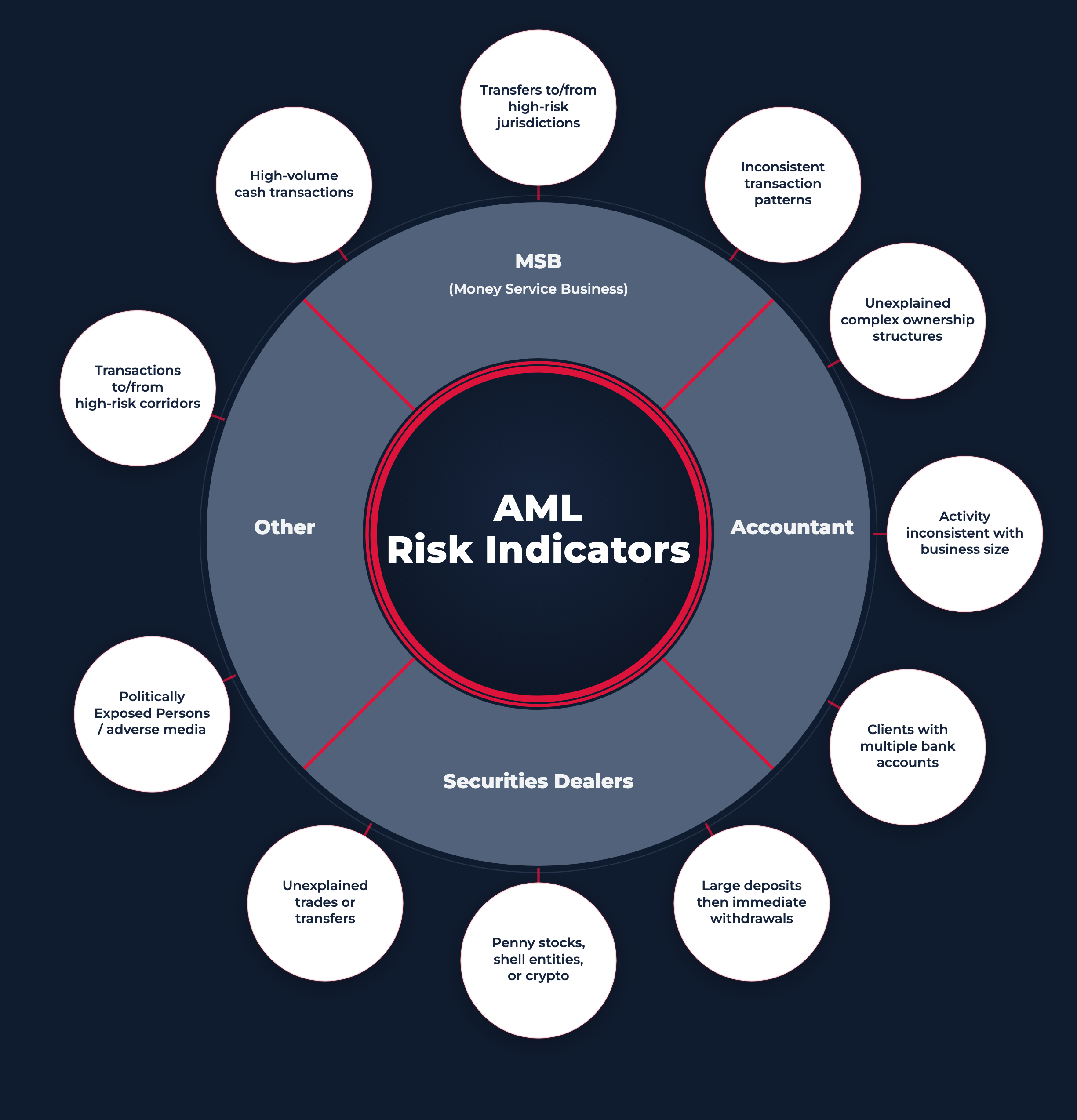
Where the exposure concentrates, sector by sector
A defensible program starts by mapping inherent risk. The ratings below reflect AA+’s risk framework across the four dimensions FINTRAC weighs most heavily.
Ready to strengthen your compliance program?
Book a free 30-minute discovery call. No obligation — just an honest assessment of where your program stands.